Q: What is astaxanthin and where does it come from?
A: Astaxanthin is a xanthophyll carotenoid a naturally occurring pigment produced by the freshwater microalgae Haematococcus pluvialis. It is the pigment responsible for the pink and red coloration of wild salmon, shrimp, lobster, crab, and flamingos. Those animals do not produce astaxanthin themselves. They obtain it by consuming algae or animals that ate algae. The algae produces astaxanthin as a survival mechanism: when Haematococcus pluvialis is exposed to intense UV radiation, drought, or nutrient deprivation, it encases itself in a protective shell of astaxanthin to shield its DNA and cellular machinery from oxidative destruction. This stress-induced accumulation is the biological origin of all natural astaxanthin, and it is what makes astaxanthin one of the most potent naturally occurring antioxidants known.
Q: What are the Health Canada approved uses for this product?
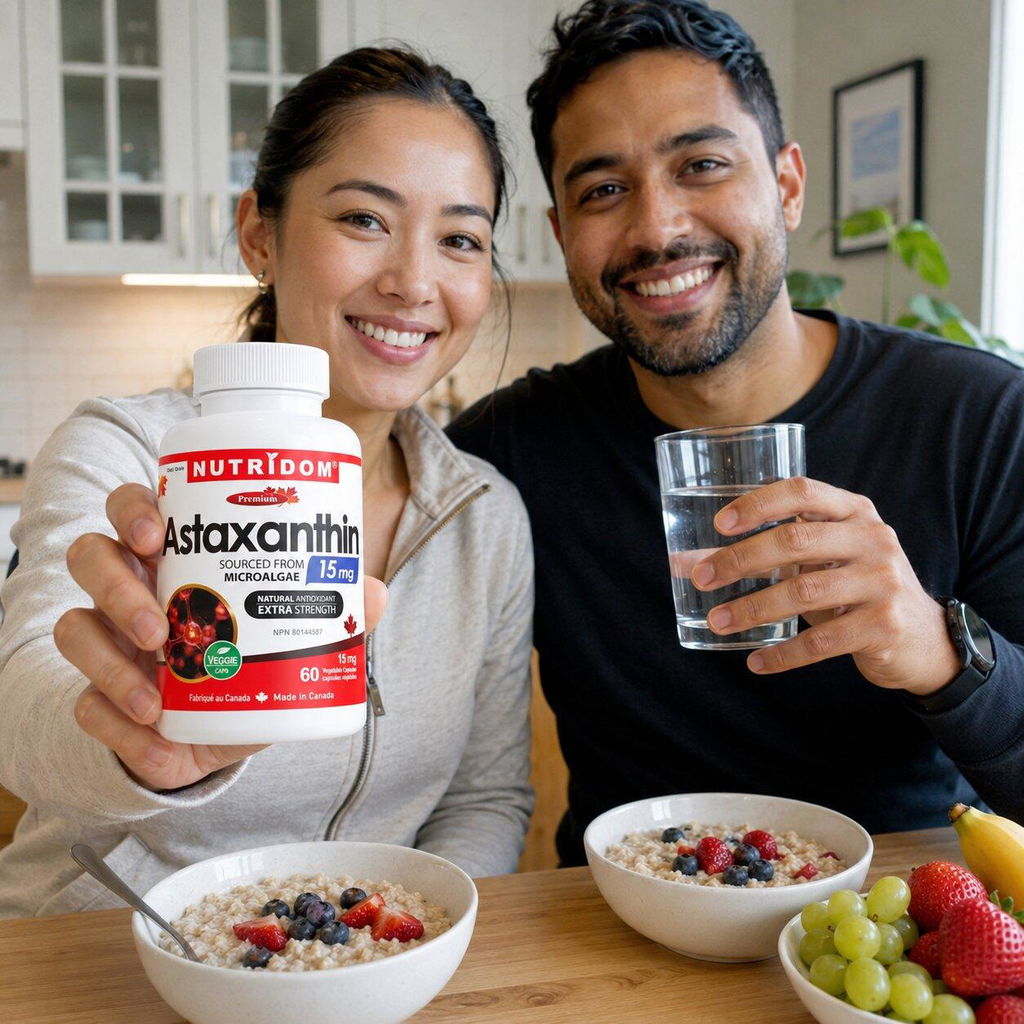
A: This product is approved by Health Canada (NPN 80144587) for the following uses: antioxidant; and helps reduce oxidative stress. This product is not intended to diagnose, treat, cure, or prevent any disease.
Q: Why is 15mg considered extra strength and how does it compare to other astaxanthin supplements?
A: Most astaxanthin supplements available on the market contain 4mg to 12mg per capsule. This formula delivers 15mg per capsule at a suggested use of 1 capsule once per day, placing it at the upper end of commonly available supplemental doses. The 15mg dose is not arbitrary astaxanthin research has used a range of doses, and higher doses have been studied for more demanding antioxidant applications. For those who want maximum antioxidant support from a single daily capsule without taking multiple capsules, 15mg represents the highest commonly available single-capsule dose.
Q: What is the difference between natural and synthetic astaxanthin?
A: Natural and synthetic astaxanthin are not the same compound in terms of biological activity. Astaxanthin has three possible stereoisomeric forms: S,S' (3S,3'S), R,R' (3R,3'R), and the meso form (3R,3'S). Haematococcus pluvialis produces predominantly the S,S' stereoisomer, which is the form found in nature and the form with the highest biological activity in the human body. Synthetic astaxanthin, produced from petrochemical precursors, is a racemic mixture of all three stereoisomeric forms, with only approximately 25% being the biologically preferred S,S' form. This means that on a per-milligram basis, natural astaxanthin from H. pluvialis is significantly more biologically active than synthetic astaxanthin. Additionally, natural astaxanthin from H. pluvialis is found in esterified form, bound to fatty acids, which is more stable and associated with better bioavailability than the free synthetic form. This formula uses whole Haematococcus pluvialis natural, not synthetic.
Q: What does "whole Haematococcus pluvialis" mean on the label?
A: Whole Haematococcus pluvialis means the complete algae biomass is used, rather than an isolated or purified astaxanthin extract. This preserves the natural esterified form of astaxanthin as it exists in the algae, alongside the full complement of naturally co-occurring carotenoids and phytonutrients present in the whole algae. The esterified form of astaxanthin found in whole H. pluvialis is more stable than free astaxanthin and is hydrolyzed to free astaxanthin during digestion for absorption.
Q: How does astaxanthin's antioxidant mechanism differ from vitamin C, vitamin E, and beta-carotene?
A: Most antioxidants work in one location. Vitamin C is water-soluble and works in the aqueous environment inside and outside cells. Vitamin E is fat-soluble and works within the interior of cell membranes but is anchored at only one surface. Beta-carotene is also fat-soluble and positioned entirely within the hydrophobic interior of the lipid bilayer. None of these antioxidants can protect the full thickness of a cell membrane from one surface to the other. Astaxanthin can. Its elongated molecule (approximately 3.4 nanometers) has polar keto-hydroxyl groups at both ends that anchor at both surfaces of the lipid bilayer, while its non-polar polyene chain spans the hydrophobic interior. This membrane-spanning orientation allows a single astaxanthin molecule to provide antioxidant protection across the entire thickness of the cell membrane a structural capability unique among commonly supplemented antioxidants.
Q: What is singlet oxygen and why is astaxanthin so effective at quenching it?
A: Singlet oxygen is a highly reactive, excited form of oxygen generated by UV radiation, photosensitization reactions, and other oxidative processes. It can directly damage lipids, proteins, and DNA and is a significant contributor to oxidative stress in skin and other UV-exposed tissues. Astaxanthin is one of the most potent singlet oxygen quenchers known, due to its extended conjugated polyene chain of 11 conjugated double bonds, which is highly effective at absorbing and dissipating singlet oxygen energy and converting it to harmless ground-state oxygen. Astaxanthin's singlet oxygen quenching capacity is approximately 6,000 times greater than vitamin C, 800 times greater than CoQ10, 550 times greater than vitamin E, and 40 times greater than beta-carotene.
Q: Can astaxanthin reach the brain and eyes?
A: Yes. Unlike many antioxidants, astaxanthin crosses both the blood-brain barrier and the blood-retinal barrier. The blood-brain barrier is a selective barrier that controls what substances can enter the brain from the bloodstream, and many antioxidants cannot cross it efficiently. The blood-retinal barrier similarly controls access to the retina. Astaxanthin's ability to cross both barriers means it can provide antioxidant support in the brain and eyes two tissues with exceptionally high metabolic activity, high oxygen consumption, and significant exposure to oxidative stress.
Q: How much astaxanthin is in wild salmon compared to this supplement?
A: Wild Pacific salmon contains approximately 40mg of astaxanthin per kilogram of flesh. A single 15mg capsule of this formula provides the astaxanthin equivalent of approximately 375 grams of wild Pacific salmon. This comparison illustrates the concentration advantage of supplemental astaxanthin from Haematococcus pluvialis, which accumulates astaxanthin to concentrations of up to 4 to 5% of its dry weight making it by far the richest natural source of astaxanthin on Earth.
Q: Why should astaxanthin be taken with food?
A: Astaxanthin is a fat-soluble carotenoid, meaning it requires dietary fat for optimal absorption from the digestive tract. Taking astaxanthin with a meal containing fat significantly improves its bioavailability compared to taking it on an empty stomach or with a fat-free meal. Taking with food also helps minimize the possibility of gastrointestinal discomfort. Any meal containing fat including healthy fats from avocado, nuts, olive oil, eggs, or fish is sufficient to support astaxanthin absorption.
Q: Why does the label say to ask a healthcare practitioner for use beyond 12 weeks?
A: Health Canada requires this precautionary statement for astaxanthin supplements based on the duration of clinical studies reviewed during the NPN approval process. Most clinical research on astaxanthin supplementation has been conducted over periods of up to 12 weeks. The statement does not indicate that astaxanthin is unsafe beyond 12 weeks, but rather that a healthcare practitioner should be consulted to assess the appropriateness of continued use for your individual health situation beyond the studied duration.
Q: Will astaxanthin turn my stool red or orange?
A: Astaxanthin is a deeply pigmented red carotenoid. In some individuals, particularly at higher doses such as 15mg per day, it may cause a reddish or orange coloration of stool. This is completely normal, harmless, and is simply the result of the pigment passing through the digestive tract. It is the same reason that wild salmon flesh is pink the pigment is visible. If you notice this, there is no cause for concern.
Q: Is this product suitable for vegans and vegetarians?
A: Yes, this astaxanthin supplement is 100% vegan and suitable for both vegans and vegetarians. The astaxanthin is derived from Haematococcus pluvialis microalgae, not from seafood. Although astaxanthin is associated with salmon and shrimp, this formula contains no animal-derived ingredients. The capsule shell is made from hypromellose (vegetable cellulose), not gelatin. All non-medicinal ingredients are plant-derived or mineral-based. The product is also non-GMO and free from gluten, dairy, and soy.