Q : Qu'est-ce que l'astaxanthine et d'où vient-elle ?
R : L'astaxanthine est un caroténoïde de type xanthophylle, un pigment naturel produit par la microalgue d'eau douce Haematococcus pluvialis. C'est le pigment responsable de la coloration rose et rouge du saumon sauvage, des crevettes, du homard, du crabe et des flamants roses. Ces animaux ne produisent pas eux-mêmes d'astaxanthine. Ils l'obtiennent en consommant des algues ou des animaux qui ont mangé des algues. L'algue produit de l'astaxanthine comme mécanisme de survie : lorsque l'Haematococcus pluvialis est exposé à un rayonnement UV intense, à la sécheresse ou à une carence en nutriments, elle s'entoure d'une coquille protectrice d'astaxanthine pour protéger son ADN et sa machinerie cellulaire de la destruction oxydative. Cette accumulation induite par le stress est l'origine biologique de toute l'astaxanthine naturelle, et c'est ce qui fait de l'astaxanthine l'un des antioxydants naturels les plus puissants connus.
Q : Quelles sont les utilisations approuvées par Santé Canada pour ce produit ?
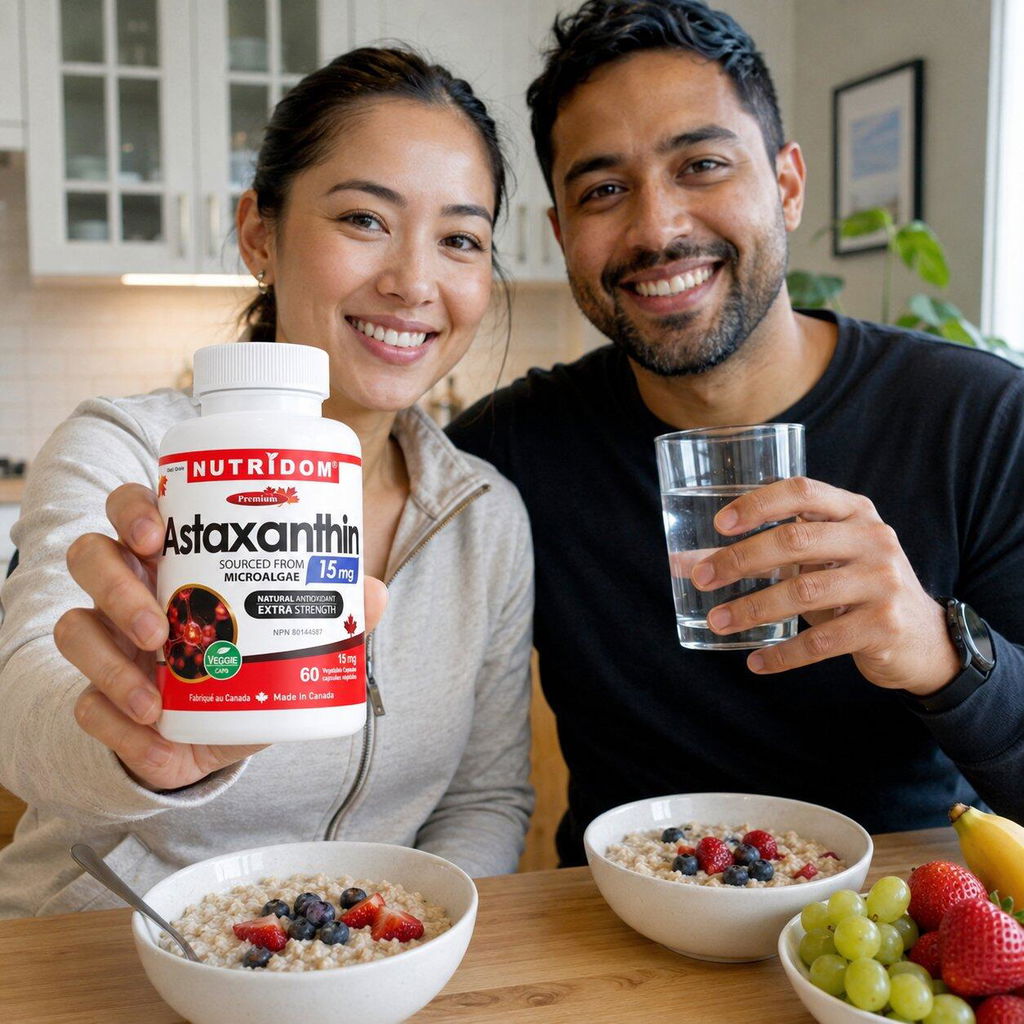
R : Ce produit est approuvé par Santé Canada (NPN 80144587) pour les usages suivants : antioxydant ; et aide à réduire le stress oxydatif. Ce produit n'est pas destiné à diagnostiquer, traiter, guérir ou prévenir toute maladie.
Q : Pourquoi 15 mg est-il considéré comme une dose extra forte et comment se compare-t-il aux autres suppléments d'astaxanthine ?
R : La plupart des suppléments d'astaxanthine disponibles sur le marché contiennent de 4 mg à 12 mg par capsule. Cette formule délivre 15 mg par capsule pour une utilisation suggérée de 1 capsule une fois par jour, ce qui la place à l'extrémité supérieure des doses supplémentaires couramment disponibles. La dose de 15 mg n'est pas arbitraire ; la recherche sur l'astaxanthine a utilisé une gamme de doses, et des doses plus élevées ont été étudiées pour des applications antioxydantes plus exigeantes. Pour ceux qui souhaitent un soutien antioxydant maximal à partir d'une seule capsule quotidienne sans prendre plusieurs capsules, 15 mg représente la dose de capsule unique la plus élevée couramment disponible.
Q : Quelle est la différence entre l'astaxanthine naturelle et synthétique ?
R : L'astaxanthine naturelle et synthétique ne sont pas le même composé en termes d'activité biologique. L'astaxanthine a trois formes stéréoisomères possibles : S,S' (3S,3'S), R,R' (3R,3'R), et la forme méso (3R,3'S). L'Haematococcus pluvialis produit principalement le stéréoisomère S,S', qui est la forme trouvée dans la nature et la forme ayant la plus haute activité biologique dans le corps humain. L'astaxanthine synthétique, produite à partir de précurseurs pétrochimiques, est un mélange racémique des trois formes stéréoisomères, avec seulement environ 25 % étant la forme S,S' biologiquement préférée. Cela signifie que sur une base par milligramme, l'astaxanthine naturelle de H. pluvialis est significativement plus biologiquement active que l'astaxanthine synthétique. De plus, l'astaxanthine naturelle de H. pluvialis se trouve sous forme estérifiée, liée à des acides gras, ce qui est plus stable et associé à une meilleure biodisponibilité que la forme synthétique libre. Cette formule utilise l'Haematococcus pluvialis entier naturel, non synthétique.
Q : Que signifie « Haematococcus pluvialis entier » sur l'étiquette ?
R : « Haematococcus pluvialis entier » signifie que la biomasse complète de l'algue est utilisée, plutôt qu'un extrait d'astaxanthine isolé ou purifié. Cela préserve la forme estérifiée naturelle de l'astaxanthine telle qu'elle existe dans l'algue, ainsi que la gamme complète de caroténoïdes et de phytonutriments naturellement co-présents dans l'algue entière. La forme estérifiée de l'astaxanthine trouvée dans H. pluvialis entier est plus stable que l'astaxanthine libre et est hydrolysée en astaxanthine libre pendant la digestion pour l'absorption.
Q : Comment le mécanisme antioxydant de l'astaxanthine diffère-t-il de celui de la vitamine C, de la vitamine E et du bêta-carotène ?
R : La plupart des antioxydants agissent à un seul endroit. La vitamine C est hydrosoluble et agit dans l'environnement aqueux à l'intérieur et à l'extérieur des cellules. La vitamine E est liposoluble et agit à l'intérieur des membranes cellulaires, mais n'est ancrée qu'à une seule surface. Le bêta-carotène est également liposoluble et entièrement positionné à l'intérieur de l'environnement hydrophobe de la bicouche lipidique. Aucun de ces antioxydants ne peut protéger l'épaisseur totale d'une membrane cellulaire d'une surface à l'autre. L'astaxanthine le peut. Sa molécule allongée (environ 3,4 nanomètres) possède des groupes céto-hydroxylés polaires aux deux extrémités qui s'ancrent aux deux surfaces de la bicouche lipidique, tandis que sa chaîne polyène non polaire s'étend dans l'environnement hydrophobe. Cette orientation traversant la membrane permet à une seule molécule d'astaxanthine d'assurer une protection antioxydante sur toute l'épaisseur de la membrane cellulaire, une capacité structurelle unique parmi les antioxydants couramment supplémentés.
Q : Qu'est-ce que l'oxygène singulet et pourquoi l'astaxanthine est-elle si efficace pour l'éteindre ?
R : L'oxygène singulet est une forme d'oxygène excitée et hautement réactive générée par les rayonnements UV, les réactions de photosensibilisation et d'autres processus oxydatifs. Il peut endommager directement les lipides, les protéines et l'ADN et contribue de manière significative au stress oxydatif de la peau et d'autres tissus exposés aux UV. L'astaxanthine est l'un des plus puissants capteurs d'oxygène singulet connus, grâce à sa longue chaîne polyène conjuguée de 11 doubles liaisons conjuguées, qui est très efficace pour absorber et dissiper l'énergie de l'oxygène singulet et la convertir en oxygène à l'état fondamental inoffensif. La capacité de l'astaxanthine à capter l'oxygène singulet est environ 6 000 fois supérieure à celle de la vitamine C, 800 fois supérieure à celle de la CoQ10, 550 fois supérieure à celle de la vitamine E et 40 fois supérieure à celle du bêta-carotène.
Q : L'astaxanthine peut-elle atteindre le cerveau et les yeux ?
R : Oui. Contrairement à de nombreux antioxydants, l'astaxanthine traverse à la fois la barrière hémato-encéphalique et la barrière hémato-rétinienne. La barrière hémato-encéphalique est une barrière sélective qui contrôle les substances pouvant pénétrer dans le cerveau depuis la circulation sanguine, et de nombreux antioxydants ne peuvent pas la traverser efficacement. La barrière hémato-rétinienne contrôle de manière similaire l'accès à la rétine. La capacité de l'astaxanthine à traverser ces deux barrières signifie qu'elle peut fournir un soutien antioxydant dans le cerveau et les yeux, deux tissus ayant une activité métabolique exceptionnellement élevée, une consommation d'oxygène élevée et une exposition significative au stress oxydatif.
Q : Quelle quantité d'astaxanthine y a-t-il dans le saumon sauvage par rapport à ce supplément ?
R : Le saumon sauvage du Pacifique contient environ 40 mg d'astaxanthine par kilogramme de chair. Une seule capsule de 15 mg de cette formule fournit l'équivalent en astaxanthine d'environ 375 grammes de saumon sauvage du Pacifique. Cette comparaison illustre l'avantage de concentration de l'astaxanthine supplémentaire provenant d'Haematococcus pluvialis, qui accumule l'astaxanthine à des concentrations allant jusqu'à 4 à 5 % de son poids sec, ce qui en fait de loin la source naturelle d'astaxanthine la plus riche sur Terre.
Q : Pourquoi l'astaxanthine doit-elle être prise avec de la nourriture ?
R : L'astaxanthine est un caroténoïde liposoluble, ce qui signifie qu'elle nécessite des graisses alimentaires pour une absorption optimale du tube digestif. Prendre de l'astaxanthine avec un repas contenant des graisses améliore considérablement sa biodisponibilité par rapport à la prendre à jeun ou avec un repas sans graisse. La prise avec de la nourriture aide également à minimiser la possibilité d'inconfort gastro-intestinal. Tout repas contenant des graisses, y compris des graisses saines provenant d'avocat, de noix, d'huile d'olive, d'œufs ou de poisson, est suffisant pour soutenir l'absorption de l'astaxanthine.
Q : Pourquoi l'étiquette dit-elle de consulter un professionnel de la santé pour une utilisation au-delà de 12 semaines ?
R : Santé Canada exige cette mise en garde pour les suppléments d'astaxanthine en fonction de la durée des études cliniques examinées pendant le processus d'approbation du NPN. La plupart des recherches cliniques sur la supplémentation en astaxanthine ont été menées sur des périodes allant jusqu'à 12 semaines. La déclaration n'indique pas que l'astaxanthine est dangereuse au-delà de 12 semaines, mais plutôt qu'un professionnel de la santé doit être consulté pour évaluer la pertinence d'une utilisation continue pour votre situation de santé individuelle au-delà de la durée étudiée.
Q : L'astaxanthine va-t-elle rendre mes selles rouges ou oranges ?
R : L'astaxanthine est un caroténoïde rouge fortement pigmenté. Chez certaines personnes, en particulier à des doses plus élevées comme 15 mg par jour, elle peut provoquer une coloration rougeâtre ou orangée des selles. C'est tout à fait normal, inoffensif et c'est simplement le résultat du passage du pigment dans le tube digestif. C'est la même raison pour laquelle la chair du saumon sauvage est rose : le pigment est visible. Si vous remarquez cela, il n'y a pas lieu de s'inquiéter.
Q : Ce produit convient-il aux végétaliens et aux végétariens ?
R : Oui, ce supplément d'astaxanthine est 100 % végétalien et convient aux végétaliens et aux végétariens. L'astaxanthine est dérivée de la microalgue Haematococcus pluvialis, et non de fruits de mer. Bien que l'astaxanthine soit associée au saumon et aux crevettes, cette formule ne contient aucun ingrédient d'origine animale. L'enveloppe de la capsule est fabriquée à partir d'hypromellose (cellulose végétale), et non de gélatine. Tous les ingrédients non médicinaux sont d'origine végétale ou minérale. Le produit est également sans OGM et exempt de gluten, de produits laitiers et de soja.